+ "person is working on their boxing form."
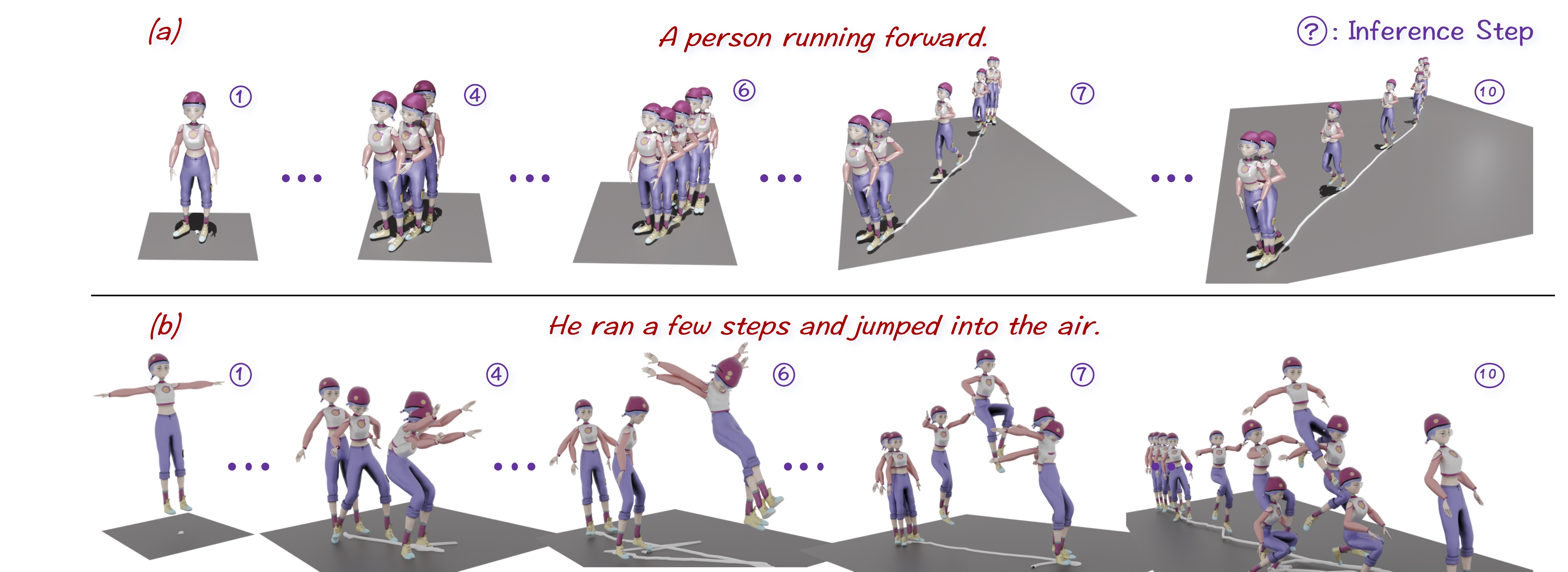
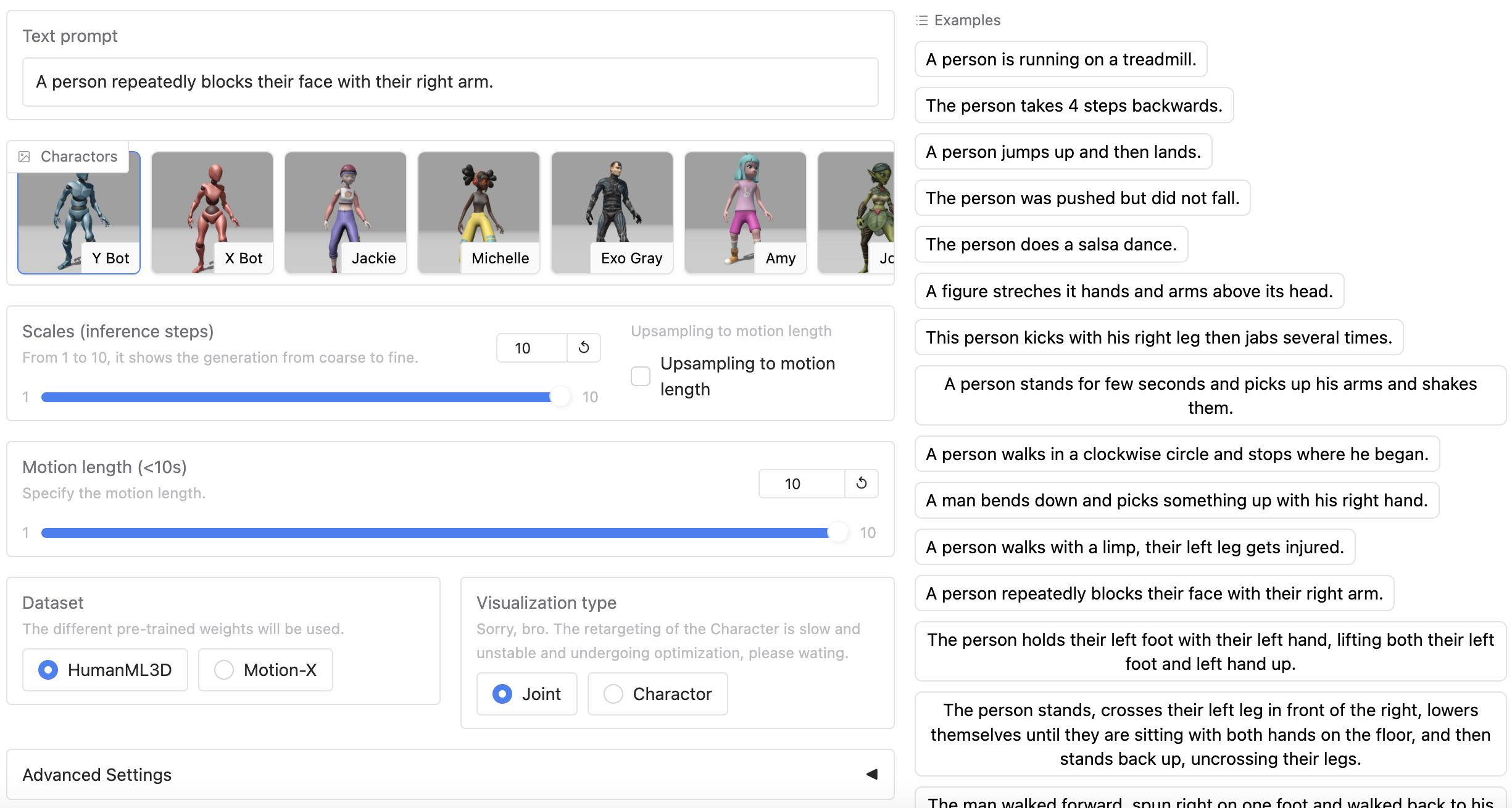
Our MoSa demonstrates a generation process from coarse to fine. The interactive program has been released, and you can adjust the "Scales" slider to intuitively experience this process! 🔥🔥🔥
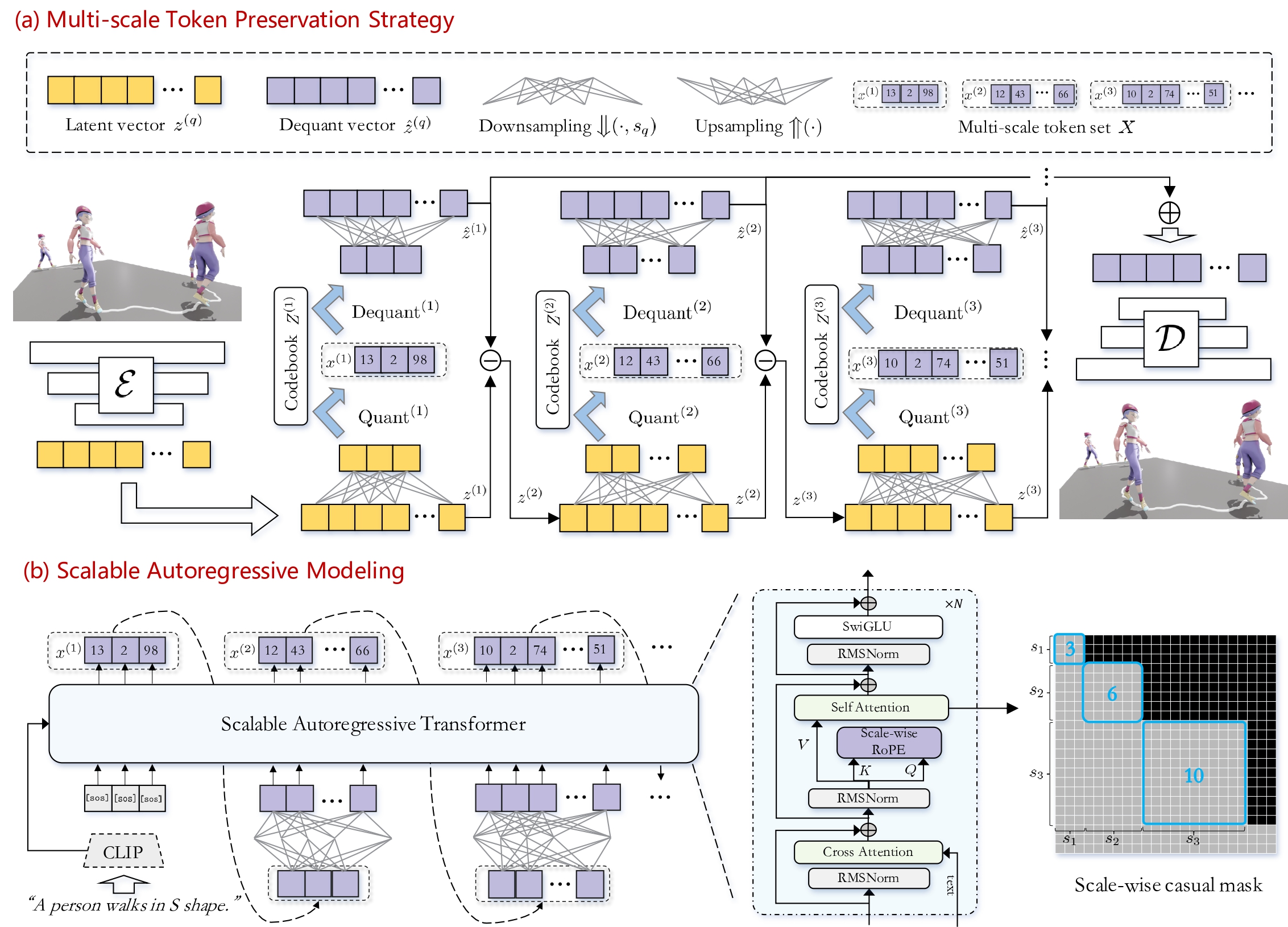
Text-driven 3D human motion generation has gained considerable attention, and the dominant Vector Quantization-guided Generative Transformers (VQ-GT) paradigm shows great promise. Recent methods adopt residual VQ to preserve fine-grained motion details with multi-layer tokens. However, the multi-fold increase in token count substantially complicates the GT phase. Existing methods typically employ two independent transformers to separately model base and residual tokens, leading to inherent cross-layer misalignment that compromises structural coherence. To address this, we introduce MoSa, a cohesive framework that reconciles quantization and generation through a coarse-to-fine hierarchical process. We propose Multi-scale Token Preservation Strategy (MTPS) that applies progressively scaled interpolations at each residual quantization layer to effectively retain multi-scale tokens. This empowers a single transformer to jointly model all hierarchical tokens via Scale-wise AutoRegressive (SAR) modeling. With this, SAR facilitates coherent cross-scale dependency modeling within a unified architecture while logically aligning inference steps with quantization layers. Furthermore, as frequent interpolation in MTPS induces reconstruction degradation, we propose CAQ-VAE, a convolution-attention hybrid VQ-VAE that enhances residual blocks and captures global dependencies for high-fidelity reconstruction. Extensive experiments demonstrate that MoSa achieves state-of-the-art performance in both generation quality and efficiency. On Motion-X, MoSa attains an FID of 0.06 (versus MoMask's 0.20) while reducing inference time by 27%. Beyond generation, we demonstrate that MoSa supports motion editing without additional fine-tuning.
"A man is walking forward then steps over an object then continues walking forward."
"A person steps forward explosively, driving his whole body into a crushing straight punch."
"a person is pushing a shopping cart."
"a person jumps forwards and turns left in mid air."
"a person was pushed but did not fall."
"a man side steps to each side, rotating his body with each side step."
"A person steps forward explosively, driving his whole body into a crushing straight punch."
"a person stands up from a kneeling position, using their right arm to help themselves up."
"a person is making a high kick with his left leg."
"a person jogs in place, slowly at first, then increases speed."
"a person starts jogging slightly forwards creating a loop and stopping."
"A person lifts his left foot above his head and grabs his left foot with his right hand."
"the person is throwing a baseball."
"the figure is appears to be grabbing something for balance at shoulder height with their right hand as they balance with on foot with their left foot and twist their right from side to side, and side to side again."
"The man walked forward, spun right on one foot and walked back to his original position."
Benefiting from our scalable autoregressive modeling paradigm, motion generation at each scale can bidirectionally attend to intra-scale context and all preceding scale representations. Leveraging this design, we further explore a compelling application of our model—Motion Editing—which requires no additional training. Motion Editing encompasses a variety of sub-tasks, including motion inpainting, outpainting, prefix filling, suffix filling, and free-form motion completion. A visualization of the results is shown below, where input motion clips are highlighted in pink, and the generated motions are depicted in red.
Generating 50% motion in the middle based on the text "person is working on their boxing form." conditioned on first 25% and last 25% of motion of "a person walks forward while being assisted by hand rails."
Source Motion
+ "person is working on their boxing form."
Generating 50% motion in the middle based on the text "a person jogs in place." conditioned on first 25% and last 25% of motion of "a person walks half a circle clockwise, then another half circle counter-clockwise."
Source Motion
+ "a person jogs in place."
Generating 25% beginning motion and 25% end motion based on the text "a person does a jumping jack." conditioned on the 50% middle motion of "a person appears to be playing tennins."
Source Motion
+ "a person does a jumping jack."
Generating 25% beginning motion and 25% end motion based on the text "someone is walking diagonally across the screen" conditioned on the 50% middle motion of "person is doing kicking motions with left leg."
Source Motion
+ "someone is walking diagonally across the screen"
Generating 50% beginning motion based on the text "a person squats down and stands up." conditioned on the 50% last motion of "a person pretends to be a dinosuar."
Source Motion
+ "a person squats down and stands up."
Generating 50% beginning motion based on the text "a person is making a high kick with his left leg." conditioned on the 50% last motion of "a person acts in a shy way while walking."
Source Motion
+ "a person is making a high kick with his left leg."
Generating 50% end motion based on the text "a person walking forward in slow motion." conditioned on the 50% beginning motion of "person is walking backwards."
Source Motion
+ "a person walking forward in slow motion."
Generating 50% end motion based on the text "a person is sitting down on the ground." conditioned on the 50% beginning motion of "a person appears to be playing the violin."
Source Motion
+ "a person is sitting down on the ground."
To validate the effectiveness of MoSa's coarse-to-fine generation, we visualize the generation process. The motion at the intermediate scale is presented. At the initial stage (eg, Scale 2, 4), the generated motion exhibits key poses but lacks proper limb coordination. As the generation progresses (eg, Scale 8, 10), the poses become increasingly natural, with more refined details.
Scale 2
Scale 4
Scale 6
Scale 8
Scale 10
Scale 2
Scale 4
Scale 6
Scale 8
Scale 10
Scale 2
Scale 4
Scale 6
Scale 8
Scale 10
Scale 2
Scale 4
Scale 6
Scale 8
Scale 10
T2M-GPT
MLD
MoMask
MoSa (Ours)
T2M-GPT
MLD
MoMask
MoSa (Ours)
T2M-GPT
MLD
MoMask
MoSa (Ours)
T2M-GPT
MLD
MoMask
MoSa (Ours)
@article{liu2025mosa,
  title={MoSa: Motion Generation with Scale-wise Autoregressive Modeling},
  author={Liu, Mengyuan and Yan, Sheng and Wang, Yong and Li, Yingjie and Bian, Gui-Bin and Liu, Hong},
  journal={arXiv preprint arXiv:2511.01200},
  year={2025}
}